
Article
How Much House Can You Actually Afford? (The Real Formula)
The bank's pre-approval number and the number you should actually spend are very different things. Here's how to find yours before you fall in love with a listing.
Why the bank's number is wrong for you
When a lender pre-approves you for a mortgage, they're answering one question: What's the maximum you can borrow without defaulting? That's a very different question from: What can you afford while still hitting your other financial goals?
Lenders use the 28/36 rule as a rough guide — your housing costs shouldn't exceed 28% of gross income, and total debt shouldn't exceed 36%. But gross income is before taxes. Before retirement contributions. Before childcare. Before the life you actually live.
The result: millions of families buy at the top of their pre-approval range and find themselves "house poor" — technically able to make the payment, but with nothing left for savings, emergencies, or anything else.
The house-poor trap
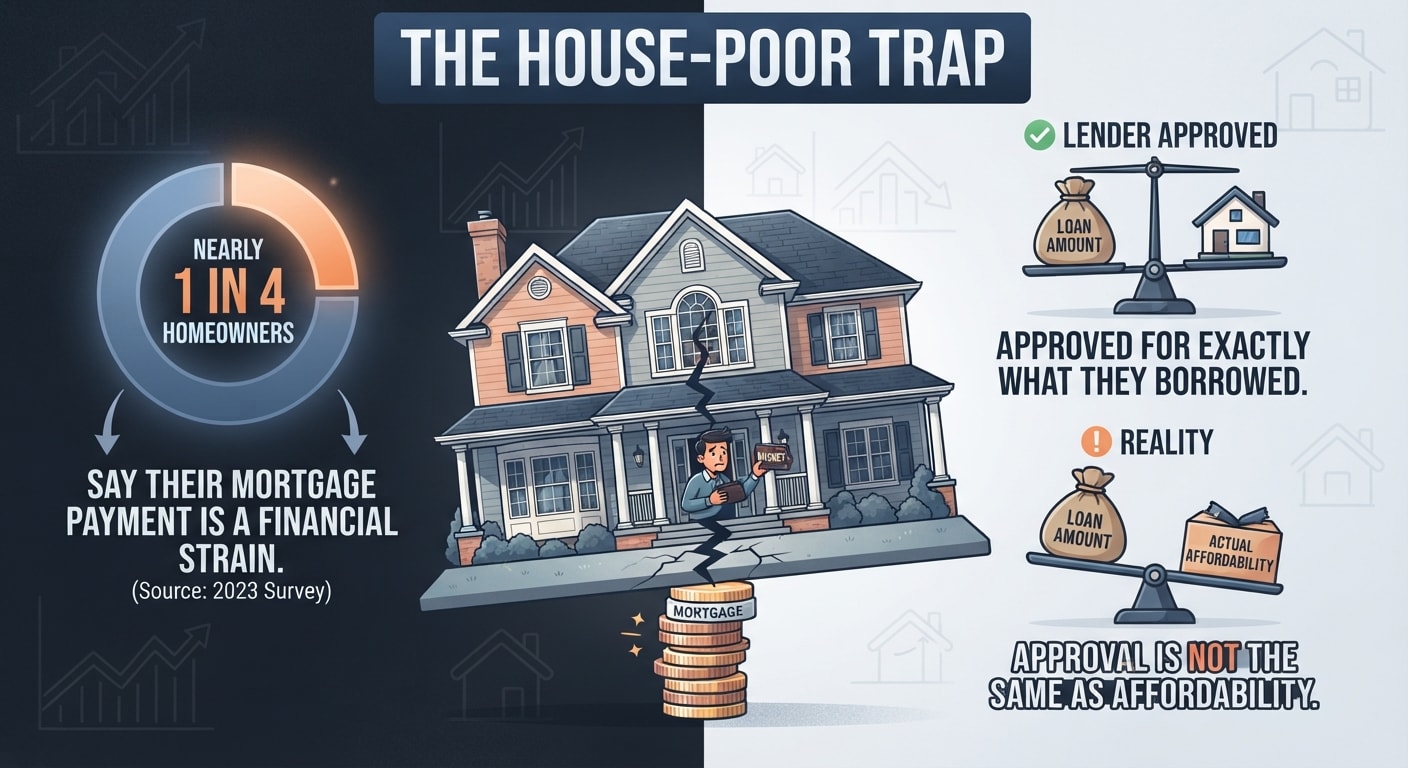
A 2023 survey found that nearly 1 in 4 homeowners say their mortgage payment is a financial strain. Most of them were approved for exactly what they borrowed. Approval is not the same as affordability.
The real formula: start with take-home pay
Instead of working from gross income, start with your actual monthly take-home pay — after taxes, after retirement contributions, after health insurance premiums. This is the money you actually have to spend.
From there, apply the 25% take-home rule: your total housing payment (mortgage principal + interest + property taxes + insurance + HOA if applicable) should not exceed 25% of your monthly take-home pay.
Example: $120,000 household income
From monthly payment to purchase price
Once you know your maximum monthly housing payment, you can work backwards to a purchase price. At a 7% 30-year fixed rate with 20% down, every $100,000 of home price costs roughly $530/month in principal and interest — before taxes and insurance.
Using the example above: a $1,700 budget minus ~$300 for taxes and insurance leaves ~$1,400 for P&I. At current rates, that supports roughly a $210,000 mortgage — or a $262,000 purchase price with 20% down.
That's likely well below what the bank would approve. But it's the number that lets you keep saving for retirement, build an emergency fund, and not panic every time the furnace needs replacing.
Try it yourself — with your actual numbers
The calculator below uses the same 25% take-home rule described above. Enter your income, debts, and down payment to get your safe purchase price, a full monthly payment breakdown, and your affordability rating.
How Much House Can You Afford?
Based on your take-home pay — not the bank's number
Your monthly take-home pay
After taxes, retirement contributions, and health insurance — the money you actually receive.
After all deductions — what hits your bank account
For educational purposes only. Results are estimates. Consult a financial professional before making home-buying decisions.
The hidden costs most buyers underestimate
- Maintenance and repairs: Budget 1–2% of the home's value per year. On a $300,000 home, that's $3,000–$6,000 annually — money that needs to come from somewhere.
- Property taxes: These vary wildly by location and can increase over time. Always look up the actual tax bill for a specific property, not just the county average.
- Homeowner's insurance: Typically $1,000–$2,500/year, but significantly higher in flood zones, hurricane corridors, or wildfire-risk areas.
- Utilities: A larger home means larger utility bills. Ask the seller for 12 months of utility history before you make an offer.
- HOA fees: Can range from $100 to $1,000+/month and often increase annually. Read the HOA financials before buying in any community.
The non-financial checklist before you buy
Even if the numbers work, make sure these boxes are checked first:
- 3–6 months of expenses in an emergency fund (separate from your down payment)
- No high-interest consumer debt (credit cards, personal loans)
- Stable employment — ideally 2+ years with the same employer
- A down payment of at least 20% to avoid PMI
- A plan to stay in the home for at least 5 years
Buying a home is one of the biggest financial decisions you'll make. The bank's job is to lend you money. Your job is to make sure the payment fits your life — not just your credit score.
How much house: quick answers
Ready to go deeper?
Take the free 5-minute assessment
Get a personalized snapshot of where you stand across six pillars — then book a free consultation if you want to talk it through with a professional.
Start My Free Assessment